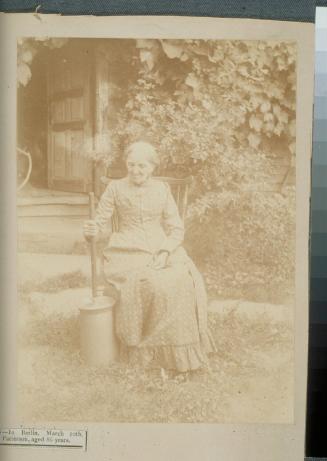
Butter Churn
MakerMade by
William States
American, 1778 - 1823
Date1799-1823
MediumChurn (.a): Wheel-thrown stoneware with a salt glaze and brown slip glaze.
Lid (.b) and dasher (.c): Wood.
DimensionsComponent (height x diameter of churn): 15 x 7 1/2in. (38.1 x 19.1cm)
Component (length of dasher .c): 25 1/2in. (64.8cm)
Component (height x diameter of lid): 1 3/8 x 6 1/2in. (3.5 x 16.5cm)
Component (length of dasher .c): 25 1/2in. (64.8cm)
Component (height x diameter of lid): 1 3/8 x 6 1/2in. (3.5 x 16.5cm)
ClassificationsArchitectural Elements
Credit LineThe Newman S. Hungerford Museum Fund
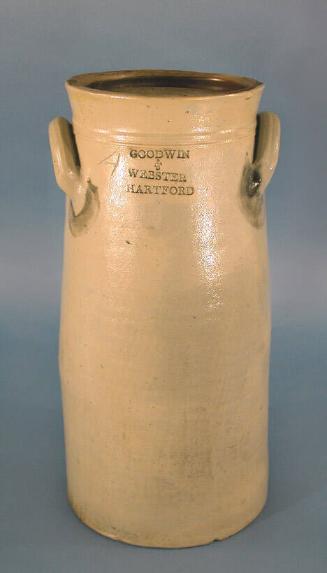
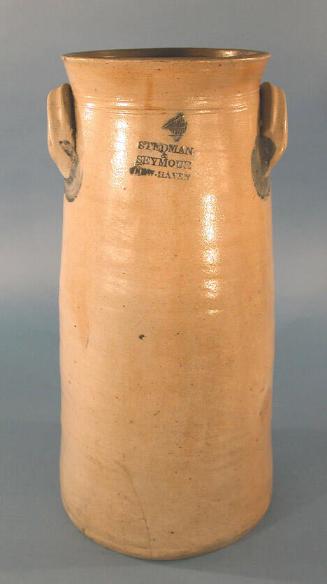
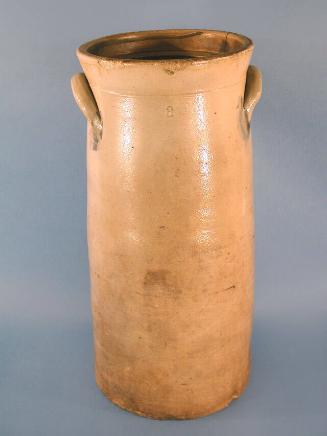
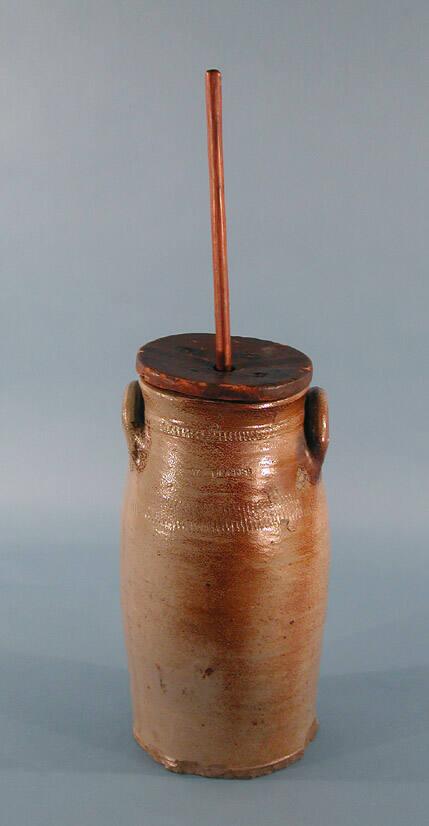
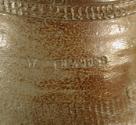
DescriptionSemi-ovoid grey stoneware churn with a salt glazed exterior and brown slip glaze, or Albany-type glaze, on the interior. The churn (.a) has a flat base, slightly swelled sides, and a plain, slightly-flared, vertical rim. The churn has an inch-tall band of decoration formed by a roulette wheel, which is lightly impressed about one third of the way down the churn. Above this, where the neck is most narrow, is a shorter band of decoration formed by a roulette wheel. Two pulled lug handles have been applied, each on opposite sides of the churn, at the neck. Brown glaze has been applied at the base of the handles. Impressed twice below the neck, once on each side of the churn, is the maker's mark, "W STATES". Above one of these marks, at the rim, is the incised number "3". There are many imperfections in the surface of the churn, and the churn itself is somewhat lopsided. The glaze, to one side, is an uneven brown color. Finally, there are more than a dozen chips of various sizes circling the base of the churn.
Lid (.b): The wooden lid of the churn is formed by two discs of wood that are held together with three iron nails. The wood that forms the top of the lid is stained brown. The disc that forms the inside of the lid is of a smaller diameter, and has significant damage from an unknown insect boring through the wood. There is no sign of current insect activity. A cylindrical hole was bored through the center of both pieces of wood.
Dasher (.c-.d): The dasher consists of a dowel rod with two pieces of wood attached in an "x" shape at one end. The dowel and "x" shape are of different kinds of wood. The dowel is stained brown at one end, and is worn in the middle, possibly where the dowel passed through the opening in the lid during churning. The x-shaped piece of wood shows significant damage from an unknown insect boring through portions of the wood. One section of the wood has broken off completely (.d).
Lid (.b): The wooden lid of the churn is formed by two discs of wood that are held together with three iron nails. The wood that forms the top of the lid is stained brown. The disc that forms the inside of the lid is of a smaller diameter, and has significant damage from an unknown insect boring through the wood. There is no sign of current insect activity. A cylindrical hole was bored through the center of both pieces of wood.
Dasher (.c-.d): The dasher consists of a dowel rod with two pieces of wood attached in an "x" shape at one end. The dowel and "x" shape are of different kinds of wood. The dowel is stained brown at one end, and is worn in the middle, possibly where the dowel passed through the opening in the lid during churning. The x-shaped piece of wood shows significant damage from an unknown insect boring through portions of the wood. One section of the wood has broken off completely (.d).
Object number2004.14.0a-d
MarkingsImpressed twice below the neck, once on each side of the churn, is the maker's mark, "W STATES". Above one of these marks, at the rim, is the incised number "3".Subject Terms
On View
On view