
The Windham Bacchus
PainterPainted by
Louis Grosvernor Frink
American, 1869 - 1956
MediumDrawing; pencil, watercolor, and gouache on brown paper on cardboard
DimensionsPrimary Dimensions (image height x width): 15 3/4 x 20in. (40 x 50.8cm)
Sheet (height x width): 15 3/4 x 20in. (40 x 50.8cm)
Mount (height x width): 15 3/4 x 20in. (40 x 50.8cm)
Sheet (height x width): 15 3/4 x 20in. (40 x 50.8cm)
Mount (height x width): 15 3/4 x 20in. (40 x 50.8cm)
ClassificationsGraphics
Credit LineN.C. Brainard Acquisition Fund and Seymour Museum Fund Income
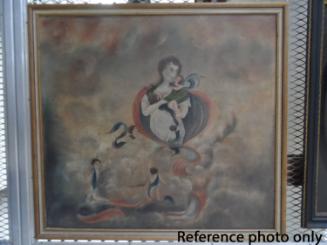
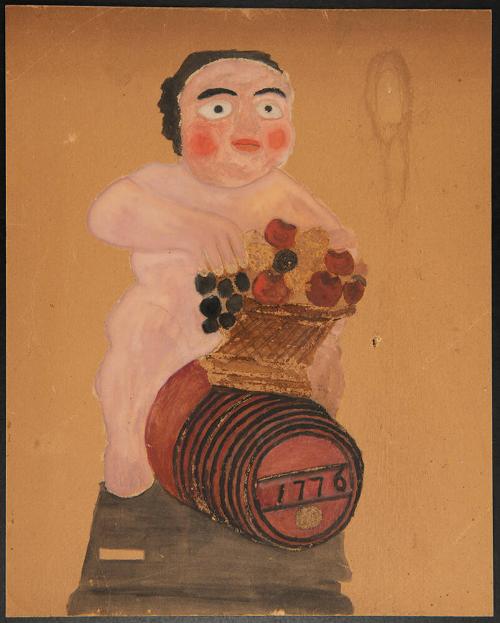
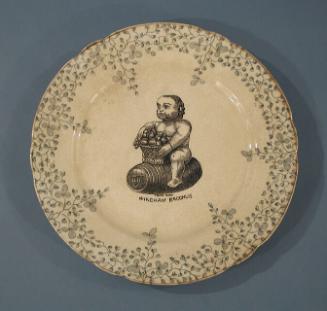
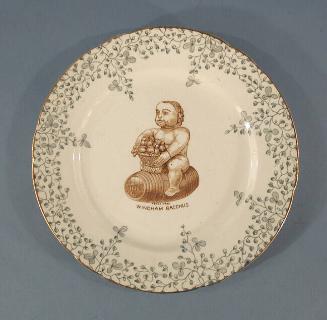
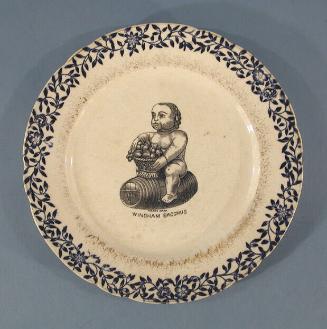
DescriptionA short cherub-like nude figure with black hair and prominent rosy cheeks sit on the mount. An alcohol cask with carved lines and reading "1776" on the lid hides the Bacchus' genitalia and acts as support for the fruit-filled wicker basket, which he steadies with one hand while plucking a grape with the other.
Object number1973.25.79
MarkingsOn verso, stamped in black ink, "American Primitives / by Lou Frink / Windham, Conn. No. 79"InscribedOn verso, upper left, in pencil, "Untitled " The Windham Bacchus"" "15y--784"Lower right, in pencil, accession number
[pencil written notes are NOT Lou's]NotesThe Windham Baccus is an iconic and historic statue carves in 1776 by British prisoners of the war. In 1776, the British ship Bombrig was captured by American naval forces in Long Island Sound and took the four British crew members, Edward Sneyd, John Coggin, John Russell, and William Cook, prisoners.
According to records, a woman known as Widow Carey, who was the owner of a tavern in Windham, took pity on the prisoners and would often bring them food and alcohol. Grateful for her kindness and charity, the prisoners asked their wardens for a large log and carved an image of Bacchus, the Roman god of wine, simply using their jackknives. Widow Carey accepted their gift and mounted it in front of her tavern.
In November, the prisoners escaped from Windham's jail and stole a canoe. Unfortunately, the canoe capsized and the men drowned except for John Coggin who survived but was recaptured.
Although the carving is called Bacchus, the representation is far from the traditional depictions of the Roman God of wine and frenzies. Historically, Bacchus, or Dionysus, was traditionally depicted as an idealized adult male sometimes wearing a crown made of vine leaves and holding grapes and a chalice full of wine. The Windham Bacchus is very much the opposite of the latter God-like depiction. Instead, he is a short jovial and cherub-like figure seated astride a cask reaching into the basket filled with fruits.
Sources:
Payne, Brigham., Weaver, William Lawton., Peters, Samuel. The Story of Bacchus: And Centennial Souvenir. United States: A. E. Brooks, 1876.
On View
Not on view
probably 1830-1840