Armchair
Furniture MakerMade by
Unknown
Date1730-1760
MediumMaple, rush
DimensionsPrimary Dimensions (overall height x width x depth): 48 1/2 x 24 1/2 x 20 15/16in. (123.2 x 62.2 x 53.2cm)
ClassificationsFurniture
Credit LineGift of Aetna Life Insurance Company
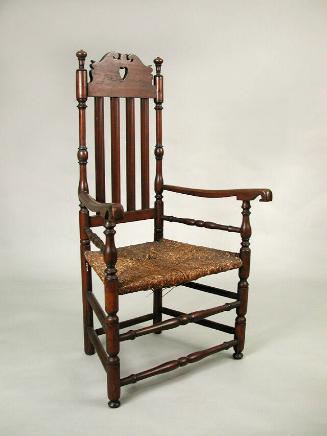
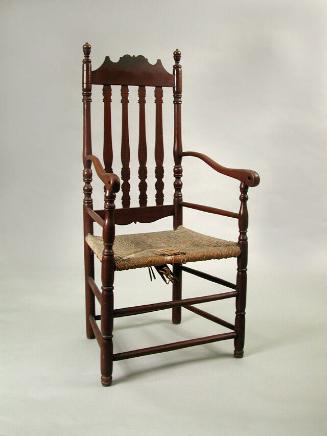
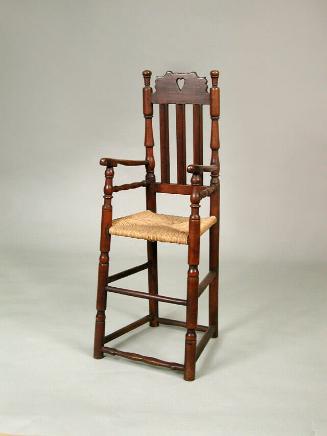
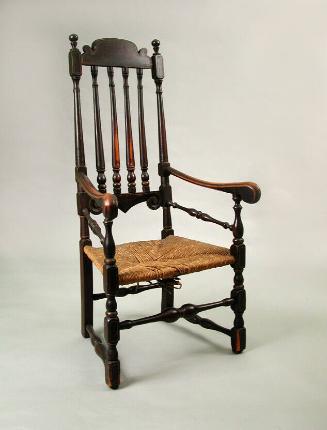
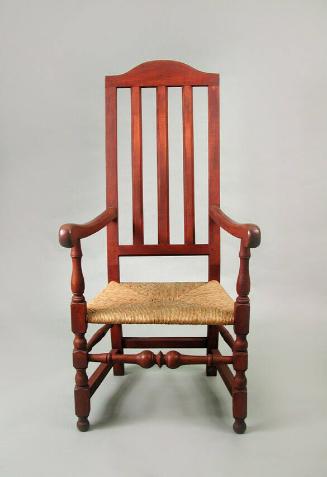
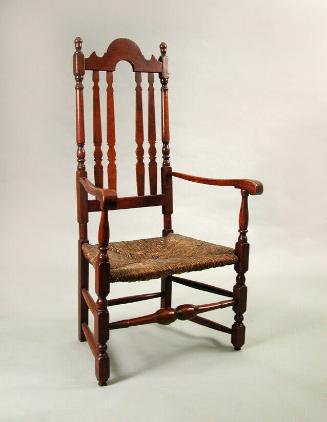
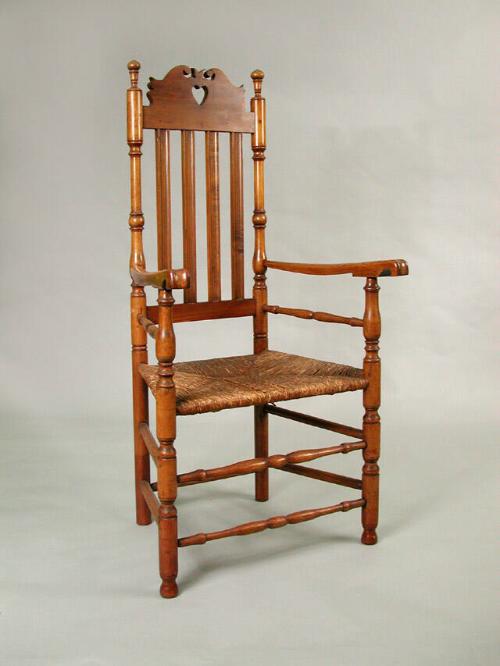
DescriptionMaple armchair in the William and Mary, or early baroque, style, with a heart and crown style crest rail, a banister-back, turned rails, front legs, and stretchers, and a rush seat. The back of the chair is formed by a pierced crest rail with a shaped upper edge at the top between two turned stiles; each stile has a ball-and-urn-shaped finial at the top. The crest rail has a wide, tall center section with a raised tulip in the center over a pierced heart; to each side of this is a scroll, a cyma curve, or S-curve, and a small spur, over an undulating edge that drops down to a small fillet, or horizontal. Below the crest rail are four banisters, each with a recessed, molded front; each banister attaches at the bottom to the stay rail. Above the seat, each stile is turned with cylinder and ring and baluster forms. Below the seat, each stile forms a cylindrical back leg. Each arm is bowed down slightly in the center and has a handhold that extends well past the top of the front leg. The top surface of each arm is rounded; the top surface of each handhold is bowed down in the center. Each front leg is turned with a baluster over three cylinders, each separated by an ovoid turning, over a turned foot. Above the seat, each front leg supports the arm. The chair has a trapezoidal rush seat. Each side of the chair has a double-baluster turned stretcher below the arm and above the rush seat, connecting the upper portion of the front leg to the stile at the back. The front of the chair has two stretchers connecting the front legs; each stretcher is turned with a double-baluster form. Each side of the chair has two plain turned stretchers, and the back has one plain turned stretcher.
Condition: The lower portion of each back leg and the foot on each front leg are replaced. The moldings on the front of each banister are rounded and not crisp. The chair is refinished, and the rush is replaced and varnished.
Design and Construction Details: The crest rail has a rectangular tenon at each side that extends into the cylinder near the top of each stile; each of these joints is secured with a wooden pin through the cylinder. Each banister is tenoned into the crest rail at the top and into the stay rail below. The stay rail has a rectangular tenon at each end that extends into the stile. The back of each arm is tenoned into the stile. The underside of the handhold is flat at the front, then deeply recessed closer to the front leg. There is a shallow notch in the underside of each arm, behind the point where it joins the front leg. Each front leg is tenoned into the arm above. Each seat rail is bladelike, with a roughly squared-off outer edge and a tapered inner edge. The seat rails and stretchers have round tenons that extend into the front or back legs. Incised lines circle the stiles and front legs, marking the placement of the stay rail, seat rails, and stretchers.
Condition: The lower portion of each back leg and the foot on each front leg are replaced. The moldings on the front of each banister are rounded and not crisp. The chair is refinished, and the rush is replaced and varnished.
Design and Construction Details: The crest rail has a rectangular tenon at each side that extends into the cylinder near the top of each stile; each of these joints is secured with a wooden pin through the cylinder. Each banister is tenoned into the crest rail at the top and into the stay rail below. The stay rail has a rectangular tenon at each end that extends into the stile. The back of each arm is tenoned into the stile. The underside of the handhold is flat at the front, then deeply recessed closer to the front leg. There is a shallow notch in the underside of each arm, behind the point where it joins the front leg. Each front leg is tenoned into the arm above. Each seat rail is bladelike, with a roughly squared-off outer edge and a tapered inner edge. The seat rails and stretchers have round tenons that extend into the front or back legs. Incised lines circle the stiles and front legs, marking the placement of the stay rail, seat rails, and stretchers.
Object number1960.42.3
InscribedBelow the arm, each stile has the letter "X" incised into the wood. The underside of the back stretcher has "CHS 42 1960 2" stamped into the wood.On View
Not on view