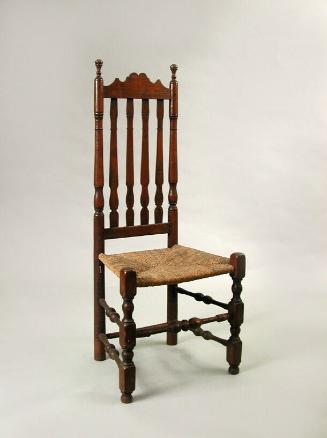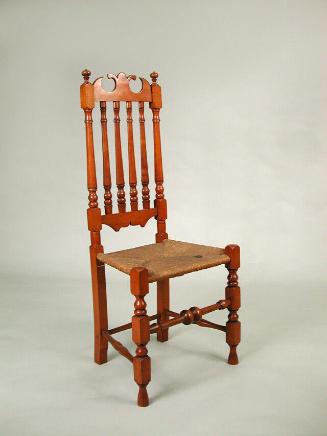
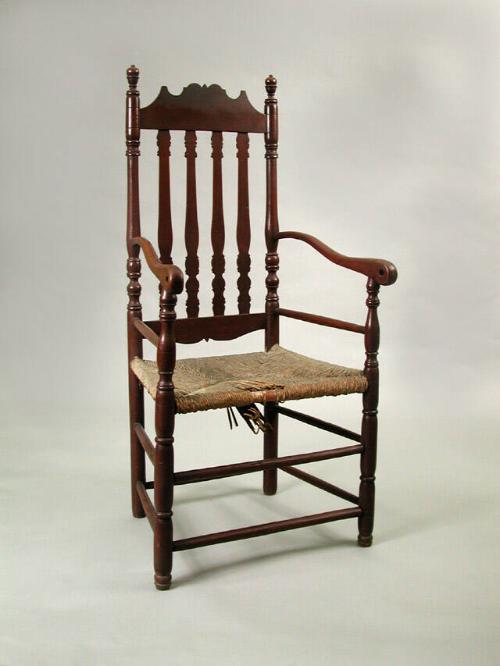
Armchair
Furniture MakerMade by
Unknown
Date1750-1775
MediumMaple, rush
DimensionsPrimary Dimensions (overall height x width x depth): 46 5/8 x 22 3/8 x 19 1/4in. (118.4 x 56.8 x 48.9cm)
ClassificationsFurniture
Credit LineConnecticut Museum of Culture and History collection
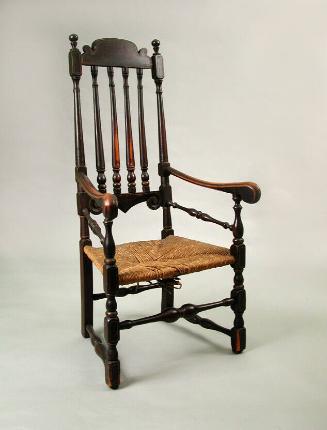
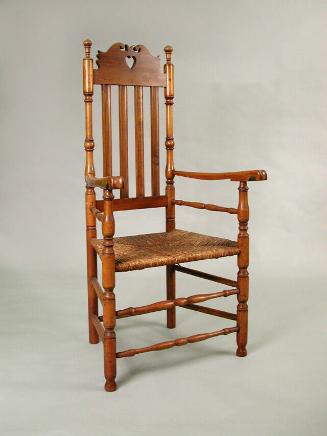
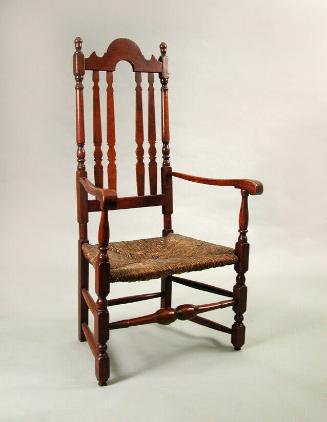
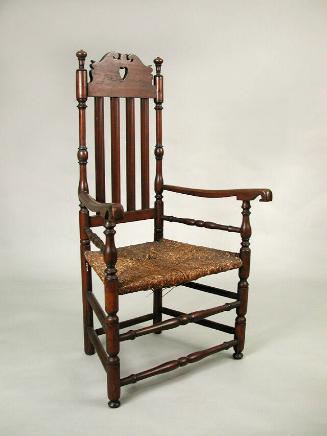
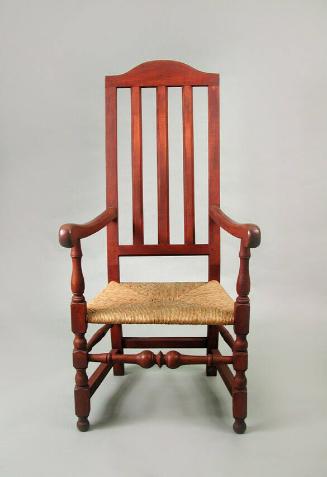
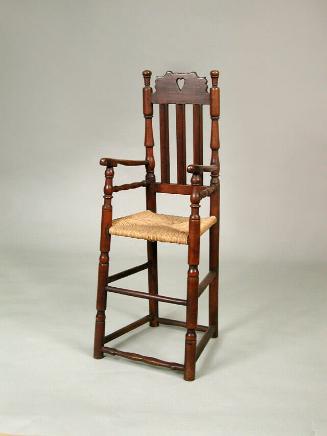
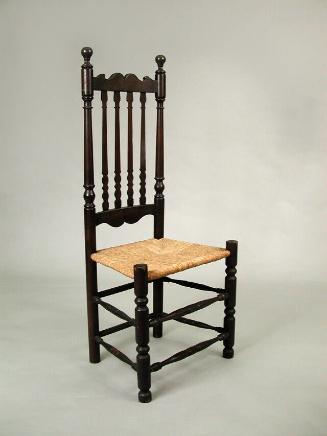
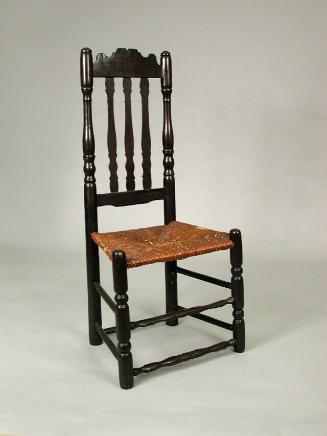
DescriptionMaple armchair in the William and Mary, or early baroque, style, with a shaped crest rail, a banister-back, turned stiles, legs, and stretchers, and a rush seat. The back of the chair is formed by a solid crest rail at the top between two stiles; each stile has an urn-shaped finial at the top. The crest rail has a shaped upper edge, consisting of a raised triangle in the middle, with a raised half circle, a fillet, or short horizontal, a recessed half circle, a raised fillet, and a recessed quarter circle to each side. Below the crest rail are four baluster-and-reel turned banisters, which attach at the bottom to a stay rail with a shaped lower edge. The banisters are turned and split; the rounded side of each banister faces the back of the chair. The shaped lower edge on the stay rail consists of an inverted triangle flanked by an undulating line that tapers up toward the stile. Below the seat, each stile forms a straight back leg and foot. Each front leg supports a downward-sloping, serpentine arm; each arm has a rounded handhold with a horizontal, cylindrical hole through the center. The lower edge of each arm is chamfered. Each front leg is turned with a baluster over three cylinders, each separated by a ring. The chair has a trapezoidal rush seat. Each side of the chair has a plain stretcher below the arm and above the seat, connecting the upper portion of the front leg to the stile at the back. The front of the chair and the two sides each have two plain stretchers. The back of the chair has one plain stretcher. The chair has an overall red finish.
Condition: Nails have been added to secure the joints where the stay rail, each arm, and some of the stretchers join the front legs and stiles. The wooden pin is missing from where the right arm joins the stile. The front feet, the arms, and the back of the upper portion of each stile are scratched and worn. The seat is replaced and has a matte white finish. Portions of the rush at the center front of the seat have broken away from the front seat rail.
Design and Construction Details: Each end of the crest rail has a rectangular tenon that extends into the cylindrical section at the top of the stile; each of these joints is secured with a wooden pin through the back. Each split spindle banister is tenoned into the crest rail at the top and into the stay rail below. Each end of the stay rail has a rectangular tenon that extends into the stile. The back of each arm is tenoned and pinned into the stile (the pin for the right arm is missing). Each front leg is tenoned and pinned into the arm above. The seat rails and stretchers have round tenons that extend into the front or back legs. Incised lines circle the stiles and legs, marking the placement of the stay rail, seat rails, and stretchers.
Condition: Nails have been added to secure the joints where the stay rail, each arm, and some of the stretchers join the front legs and stiles. The wooden pin is missing from where the right arm joins the stile. The front feet, the arms, and the back of the upper portion of each stile are scratched and worn. The seat is replaced and has a matte white finish. Portions of the rush at the center front of the seat have broken away from the front seat rail.
Design and Construction Details: Each end of the crest rail has a rectangular tenon that extends into the cylindrical section at the top of the stile; each of these joints is secured with a wooden pin through the back. Each split spindle banister is tenoned into the crest rail at the top and into the stay rail below. Each end of the stay rail has a rectangular tenon that extends into the stile. The back of each arm is tenoned and pinned into the stile (the pin for the right arm is missing). Each front leg is tenoned and pinned into the arm above. The seat rails and stretchers have round tenons that extend into the front or back legs. Incised lines circle the stiles and legs, marking the placement of the stay rail, seat rails, and stretchers.
Object number1950.251.0
Subject Terms
On View
Not on view