Roundabout Chair
Original OwnerOriginally owned by
Captain Elizur Talcott
American, 1709 - 1797
Furniture MakerMade by
Unknown
Date1780-1810
MediumWood (possibly cherry), rush
DimensionsPrimary Dimensions (overall height x width x depth): 29 7/8 x 27 x 24in. (75.9 x 68.6 x 61cm)
ClassificationsFurniture
Credit LineBequest of Mary K. Talcott
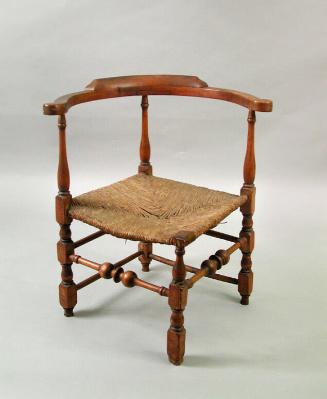
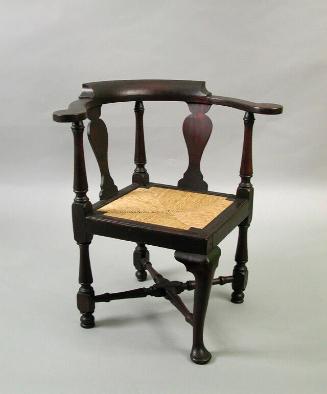
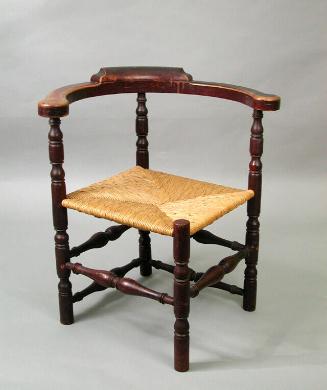
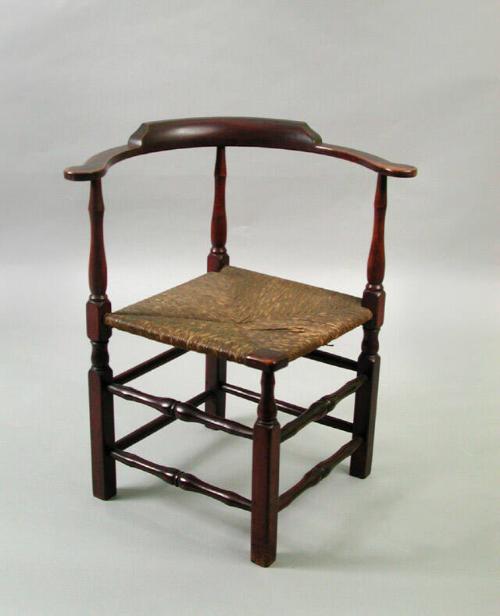
DescriptionCherry roundabout chair in the William and Mary, or early baroque, style, with a semi-circular crest and arm rail, turned stiles, legs, and stretchers, and a square rush seat. The back of the chair is formed by a flat crest rail with a tapered, undulating end each side, atop a semi-circular arm rail with a flat scrolled handhold at each end. This is supported at the sides and back of the chair by three stiles turned with baluster and block forms over a straight, square lower leg and foot. The rush seat is square, and is supported by the three stiles at the sides and back and by a leg at the front. The front leg consists of a separate block over a turned baluster form over a straight, square lower leg and foot. Each of the four sides of the chair has two turned stretchers. The stretchers at the front are each turned with a double-baluster form. The back turned stretchers are plain. The roundabout chair has an overall brown finish.
Condition: The front foot is well scratched and worn. A few pieces of rush on the seat are broken. The frame is refinished and the rush is replaced.
Design and Construction Details: The crest rail is constructed of a single piece of wood. The flat arm rail is constructed in three sections that are butted together; a longer, curved, section ending in the handhold flanks a short, curved, center section. The crest rail and armrest are joined with wooden pins through the underside. The arm rail is supported on a tenons at the top of the three stiles; the tenon at each end of the arm rail is a through tenon and is secured with a wooden pin. The seat rails are bladelike, with a rounded outer edge and a tapered inner edge, and are tenoned into the stiles and into a block at the top of the front leg. The block has two rounded top side edges and is supported on a tenon at the top of the front leg; this joint is secured with a nail through the top. The stretchers are tenoned into the stiles and front leg.
Condition: The front foot is well scratched and worn. A few pieces of rush on the seat are broken. The frame is refinished and the rush is replaced.
Design and Construction Details: The crest rail is constructed of a single piece of wood. The flat arm rail is constructed in three sections that are butted together; a longer, curved, section ending in the handhold flanks a short, curved, center section. The crest rail and armrest are joined with wooden pins through the underside. The arm rail is supported on a tenons at the top of the three stiles; the tenon at each end of the arm rail is a through tenon and is secured with a wooden pin. The seat rails are bladelike, with a rounded outer edge and a tapered inner edge, and are tenoned into the stiles and into a block at the top of the front leg. The block has two rounded top side edges and is supported on a tenon at the top of the front leg; this joint is secured with a nail through the top. The stretchers are tenoned into the stiles and front leg.
Object number1917.6.3
NotesSubject Note: Roundabout chairs, or corner chairs, can be found in Connecticut inventories as early as 1705, when Israel Chauncey's estate was assessed in Stratford. They were made by urban craftsmen up to the time of the Revolution, and continued to be produced by rural chairmakers into the nineteenth century. At times, roundabout chairs were produced en suite with larger groups of furniture, or they were made in pairs. The precise function of roundabout chairs has not been determined. Due to their form, they were well suited for use as desk or writing chairs. Roundabout chairs may have also served as library chairs, as suggested by a portrait of John Bours by John Singleton Copley (1738-1815) in the Worcester Art Museum (1908.7). The portrait shows John Bours seated in a roundabout chair with a book in his hand. (Hunt 3/30/2006)On View
Not on view