Louis Grosvernor Frink
Louis Grosvenor Frink was born in Ohio on May 16, 1869, to Edwin Smith Frink and Mary C. Thayer. The family relocated to Windham, Connecticut, when Louis was only a year old, returning to a community where they held deep ancestral ties. This move established an enduring connection to the town that would later occupy the center of both his life and his artistic experience. After a period of schooling in Boston, where the 1880 census records him living on Dudley Street, Frink returned to Windham by 1890 to live with his grandparents. He quickly became active in the community, even serving on the decoration committee for the town’s 1892 bicentennial celebrations.
Frink’s personal and creative development was defined by his integration into Windham’s social circles, most notably his proximity to the American Impressionist J. Alden Weir. By 1910, census records show Frink working as a caretaker on a private estate while residing in the same neighborhood as Weir. This proximity blossomed into a profound and somewhat documented friendship.
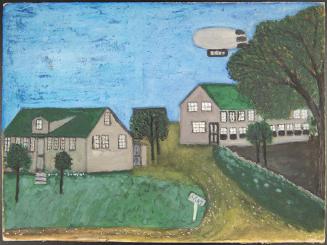
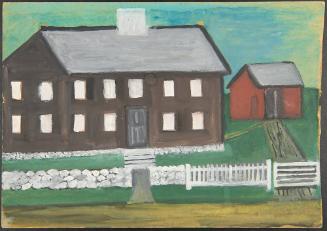
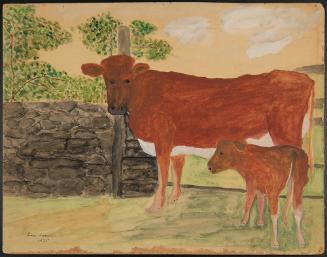
The two men were frequent companions, often spending days hunting and fishing together. Weir’s correspondence frequently mentions "Lou," and the artist often took Frink to his studio and on various painting excursions. By 1940, Frink had moved into the 1781 farmhouse on the Baker–Weir estate, serving as the official caretaker. Given these shared experiences, it is unsurprising that many of Frink’s later works depict scenes directly connected to Weir and his family, including depictions of the house (1973.25.38), family members (1973.25.28), and pets (1973.25.32, 1973.25.50, 1973.25.89).
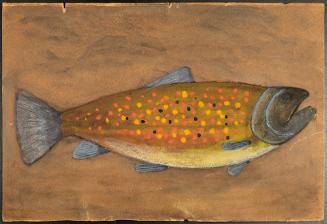
Throughout these decades, Frink’s roles mirrored the semi-rural character of Windham. Once listed as a farmer in the 1917 military census and later as an "overseer" by 1920. Over the years, Lou became an amateur photographer, capturing his neighborhood and outdoor trips with his friends. Frink was known as an enthusiastic fisherman and even identified Windham’s Cold Brook in his drawings as a "great trout stream" (1973.25.7).
Though he spent many years surrounded by artists, Frink did not begin painting until approximately 1933. According to a 1956 Yankee magazine article, his entry into art began during a two-month convalescence for ulcers. While bedridden, he discovered paintings left in his home by the previous tenant, Emil Carlson, an artist and friend of Weir. Inspired, Frink produced his first work: a village scene on cardboard.
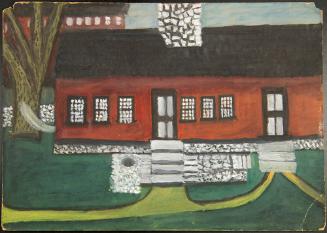
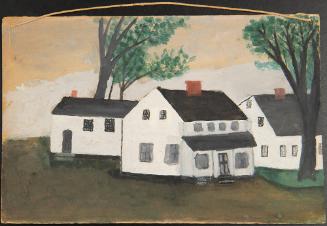
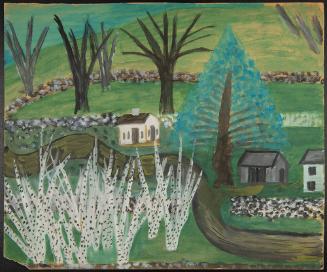
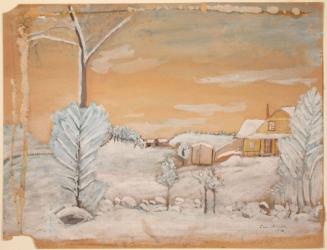
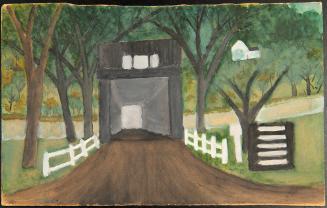
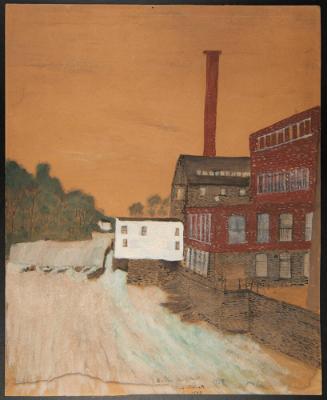
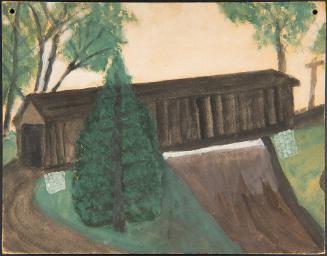
Frink’s style is characterized by a "hybrid method" that blended photographic reference with personal memory. His work is notable for their unique style and characteristics. For instance, the atmospheric focus prioritizes the "mood" and atmosphere of a scene over precise details. In addition, many of his drawings feature compositions set at a slight distance, reflecting his habit of drawing from recollection rather than direct observation. Finally, even with characteristically abstract facial features, Frink successfully conveyed a clear sense of emotion and surprise in his subjects.
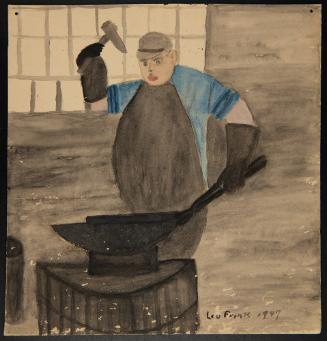
Frink’s surviving works provide a vivid portrayal of Windham’s cultural and physical landscape. He was particularly drawn to local landmarks and neighbors; for instance, the town's blacksmith and his shop appears as a recurring motif across several drawings (including 1973.25.19, 1973.25.40, 1973.25.41, 1973.25.42, 1973.25.64, and 1973.25.86).
While he painted largely for his own enjoyment, his talent eventually gained public recognition. The Lyman Allyn Museum exhibited his work in 1948, and in 1973, the Connecticut Museum of Culture and History acquired a substantial portion of his drawings, establishing the world’s largest collection of his work.
Sources:
University of Connecticut Libraries, A Memorial Volume of the Bi-Centennial Celebration of the Town of Windham, Connecticut. Containing the Historical Addresses, Poems, and a Description of Events Connected with the Observance of the Two Hundreth Anniversary of the Incorporation of the Town, as Held in the Year 1892 (Hartford, Connecticut: The New England Home Printing Co., 1893).
Lawrence Willard, “Lou Frink, Connecticut Primitive,” Yankee (October 1956), 54-55.
Eastern Connecticut State University Archives.
Dawson, Anne. Rare Light: J. Alden Weir in Windham, Connecticut, 1882–1919. United States: Wesleyan University Press, 2016.
Cummings, Hildegard., Fusscas, Helen K., Larkin, Susan G.. J. Alden Weir: A Place of His Own. United States: William Benton Museum of Art, University of Connecticut, 1991.
Martin Moebus is a primary source for Frink information.
Patron Martin Moebus is a primary source for Frink information.