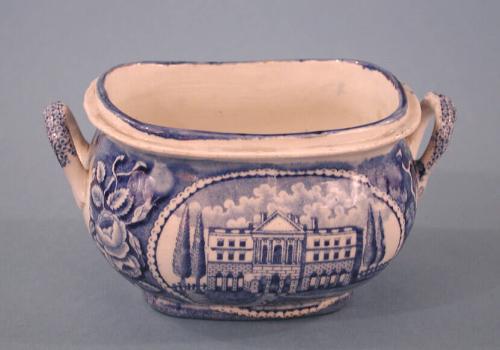
Sugar Bowl
MakerAttributed to
Andrew Stevenson
English, 1816 - 1830
Date1816-1830
MediumMold-formed buff-colored earthenware with a blue-tinted glaze and underglaze cobalt blue decoration
DimensionsPrimary Dimensions (height x width x depth): 6 1/2 x 3 1/2in. (16.5 x 8.9cm)
ClassificationsCeramics
Credit LinePossibly a gift of Morgan B. Brainard or his estate
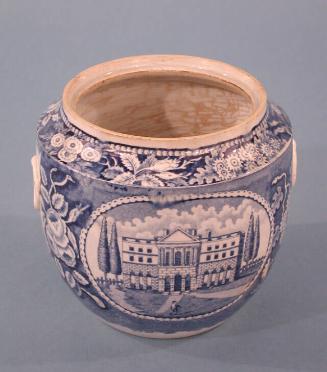
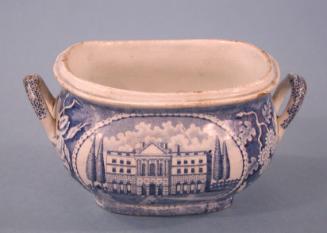
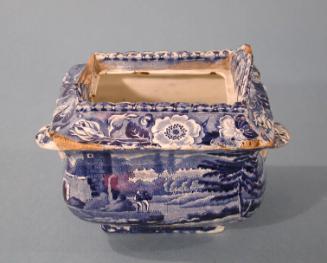
DescriptionRectangular sugar bowl of buff-colored earthenware with a blue-tinted glaze, a type of ceramic known as pearlware. The sugar bowl sits on a rectangular foot and has swelled sides that narrow just before flaring at the rim. Two semi-circular molded handles have been applied at opposite ends of the sugar bowl over two mold lines. The sugar bowl is decorated with a transfer-printed underglaze cobalt blue pattern titled, "State House Hartford" on the bottom. The pattern shows a neoclassical, or Federal style, building. The building sits on a tall, stone first floor, with two brick storeys above it. The structure has a projecting portico with six columns, a balustrade, and four chimneys emerging from the roof. There are two tall trees on either side of the building and a fence in the background. A man with a cane or walking stick is standing on the lawn in front of the building. The pattern is printed twice on opposite sides of the sugar bowl. Each pattern is surrounded by a circular border of white geometric shapes, then various flowers and leaves on a blue field. The sugar bowl had a lid at one time, although it is now missing. There is some crazing and discoloration on the inside of the sugar bowl only, most noticeably at one corner of the form. A few spots of light brown discoloration are also evident on the inside of the sugar bowl.
Object number1950.295.0
MarkingsThere is one mark on the bottom of the sugar bowl; it is the pattern name, "State House/ HARTFORD" printed in underglaze blue.NotesSubject Note: The Connecticut State House was designed by Charles Bulfinch of Boston, and built by Jeremiah Halsey of Preston, Connecticut, and Andrew Ward of Guilford, Connecticut. The first session of the General Assembly was held in the State House on 11 May 1796. In 1878, the State House was turned over for use as a City Hall. In 1915, the Old State House was abandoned, and used intermittently for various non-governmental purposes. Several restoration projects took place over the following years, and in 1961, the Old State House was designated a National Historic Landmark. (Hunt 11/4/2004)On View
Not on view