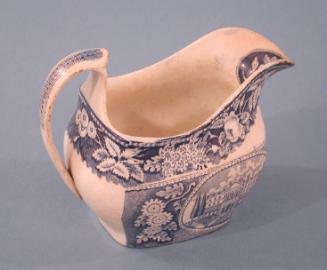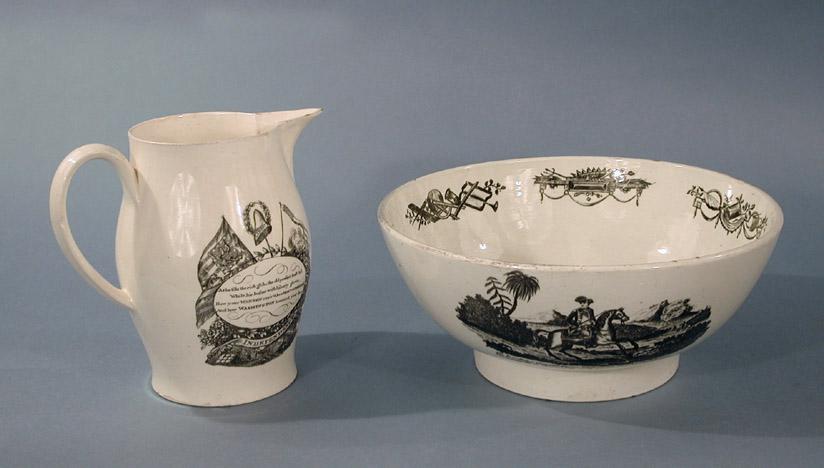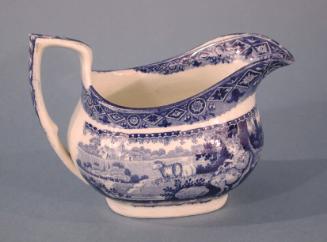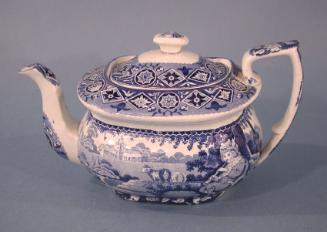
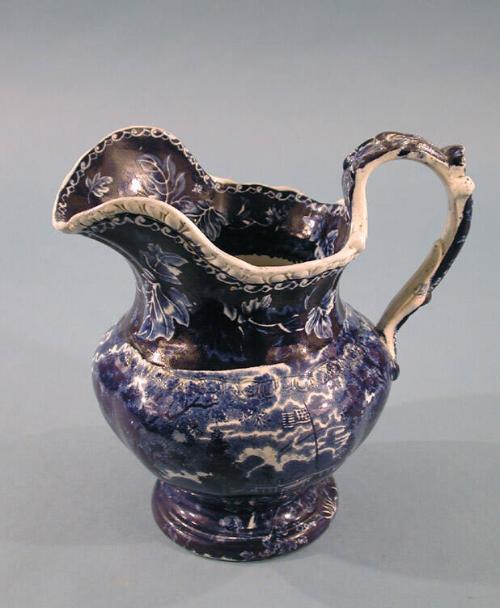
Pitcher
MakerMade by
Staffordshire potteries
English, 17th century-present
Dateabout 1830-1850
MediumMold-formed buff-colored earthenware with a blue-tinted glaze and underglaze cobalt blue decoration
DimensionsPrimary Dimensions (height x width x depth): 9 3/8 x 9 1/2 x 7in. (23.8 x 24.1 x 17.8cm)
ClassificationsCeramics
Credit LineGift of the heirs of Morgan B. Brainard
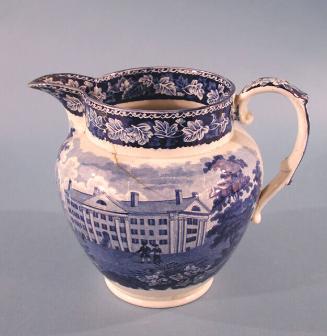
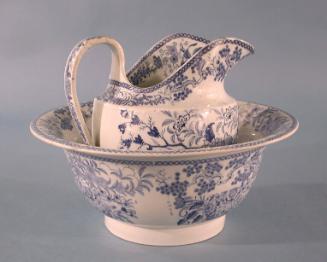
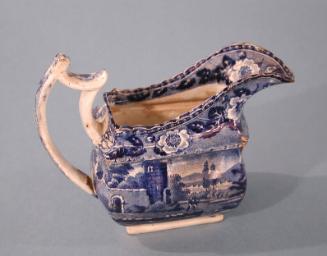
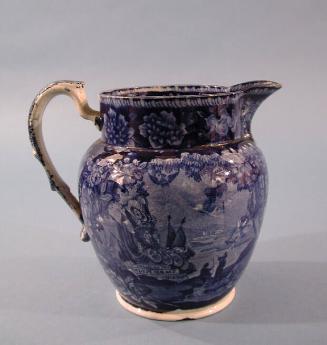
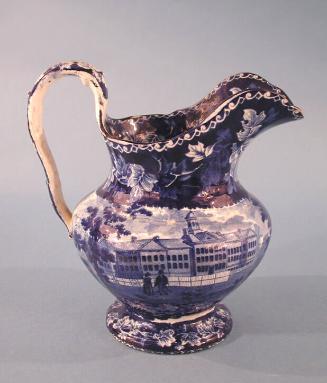
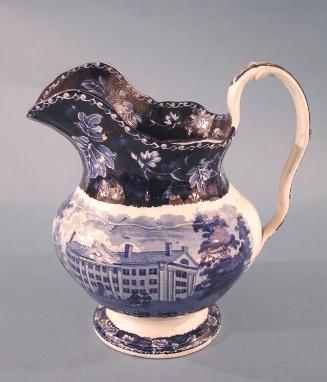
DescriptionRound, wide pitcher of buff-colored earthenware with a blue-tinted glaze, a type of ceramic known as pearlware. The pitcher is decorated with two different dark blue underglaze transfer-printed patterns showing buildings in a forested landscape. The first pattern, to the left of the handle, shows a building with the words "CASTLE GARDEN" over the door. The structure has a viewing platform on the top and looks out over a body of water with hills in the distance. Clouds and a tall flag are above the building, and two men are walking in the foreground. The second pattern to the right of the handle shows a four-story building beneath a cloudy sky. The pitcher's tall neck is decorated both inside and out with a border of leaves on a field of dark blue. There is raised molded decoration where the body of the pitcher meets the neck and spout, and again at the rim of the spout. The pitcher also has an elaborately molded handle that has been decorated with additional transfer-printed patterns. There is one small chip of glaze missing from the pattern near the word "CASTLE", one small chip on the neck, and one chip missing from the rim of the pitcher. All surfaces show crazing.
Object number1961.12.31
MarkingsThere is a small incised circle on the bottom of the pitcher, and what may be a hand-painted underglaze blue mark of the number "3".NotesHistorical Note: Castle Garden was originally constructed as a fort on the southwest battery of Manhattan to protect New York Harbor. In 1817, the fort was renamed Castle Clinton in honor of DeWitt Clinton, Mayor of New York City. The structure was given to New York City in 1823, and in 1824 a resturant and entertainment center opened at the site, then renamed Castle Garden. A roof was added in the 1840s, and Castle Garden served as an opera house and theater until 1854. In 1855, it was converted into an immigrant reception center, a precursor to Ellis Island. The site is now owned by the National Park Service. (Hunt 8/30/2004)On View
Not on view