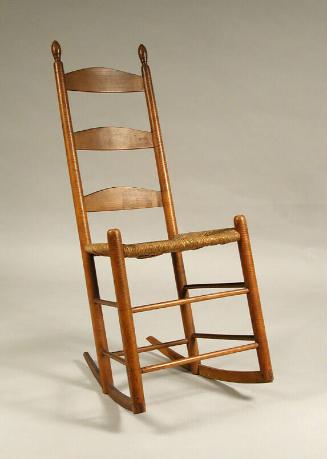
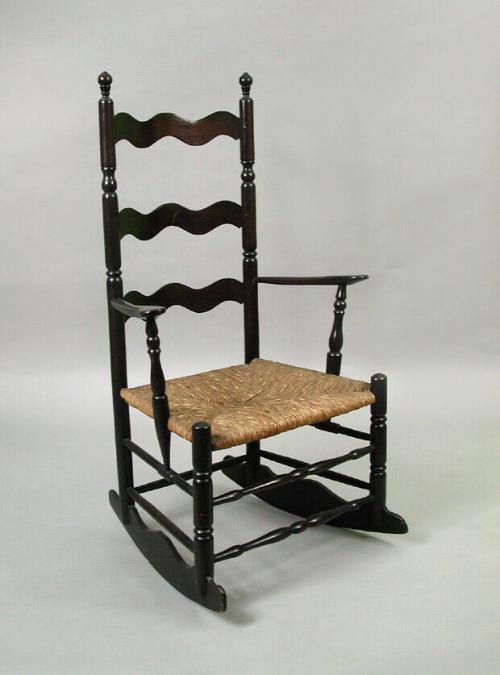
Rocking Chair
Original OwnerOriginally owned by the
Treat family
American
Furniture MakerMade by
Unknown
Date1750-1780
MediumMaple, ash, rush
DimensionsPrimary Dimensions (overall height x width x depth): 43 1/4 x 23 1/16 x 23in. (109.9 x 58.6 x 58.4cm)
ClassificationsFurniture
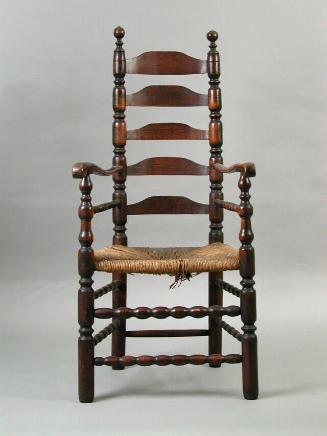
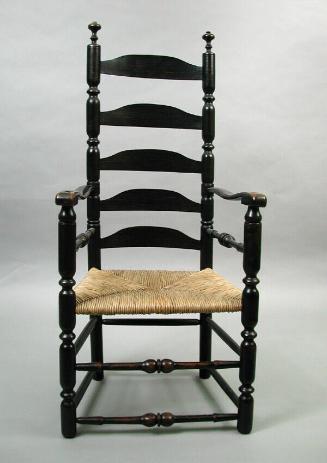
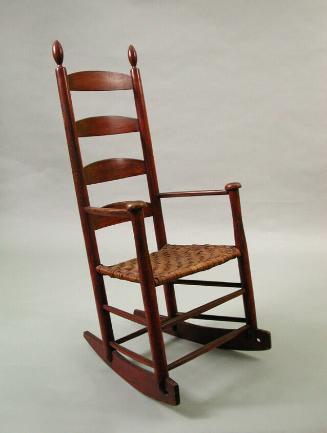
DescriptionMaple rocking chair in the William and Mary, or early baroque, style, with arms, a wavy slat-back, turned stiles, front legs, arm supports, and stretchers, and a rush seat. The back of the rocking chair is formed by three slats between two turned stiles; each stile has a ball-and-urn-shaped finial at the top, over cylinder, baluster, and ring forms. The slats are curved back in the center, and each has a wavy, or undulating, profile. Below the seat, each stile forms a cylindrical back leg. Each arm is slightly bowed and has a handhold that extends just past the top of the arm support. Each arm support is turned with a ring and baluster form, over a tapered base that extends down to the upper stretcher on that side. Each front leg is turned with three cylinder forms, each separated by a ring. Each front leg has a rounded top that extends slightly higher than the rush seat, which is trapezoidal in shape. The front of the chair has two slender stretchers that connect the front legs, each turned with baluster and ovoid forms. Each side of the chair has two plain turned stretchers. The back has one plain turned Each rocker has a wavy top edge that echoes the shape of the slats. The rocking chair frame is painted black.
Condition: The center slat has cracked, or split in the center. The chair is repainted, and the rush is replaced.
Design and Construction Details: Each slat is tenoned and pinned into each stile. The back of each arm is tenoned into the stile; each of these joints is secured with a nail. Each arm support is tenoned into the arm above and into the upper side stretcher below. Each seat rail is probably bladelike, with a rounded outer edge and a tapered inner edge. The seat rails are tenoned into the top of the legs. The stretchers are tenoned into the front or back legs. Each rocker is constructed of a shaped board that fits into a groove on the underside of each leg; each of these joints is secured with wooden pins and possibly nails. Faint grooves circle the stiles and legs, marking the placement of the slats, seat rails, and stretchers.
Condition: The center slat has cracked, or split in the center. The chair is repainted, and the rush is replaced.
Design and Construction Details: Each slat is tenoned and pinned into each stile. The back of each arm is tenoned into the stile; each of these joints is secured with a nail. Each arm support is tenoned into the arm above and into the upper side stretcher below. Each seat rail is probably bladelike, with a rounded outer edge and a tapered inner edge. The seat rails are tenoned into the top of the legs. The stretchers are tenoned into the front or back legs. Each rocker is constructed of a shaped board that fits into a groove on the underside of each leg; each of these joints is secured with wooden pins and possibly nails. Faint grooves circle the stiles and legs, marking the placement of the slats, seat rails, and stretchers.
Object number1986.44.0
InscribedA brass plaque is nailed to the inside surface of the left rocker. The plaque reads, "THIS CHAIR WAS IN THE HOME OF GOV. ROBT. TREAT/ CONNECTICUT'S THIRD GOVERNOR, FROM 1693-1698./ A SON, ROBERT, SETTLED IN MILFORD/ THIS CHAIR WAS GIVEN TO DR. FRANK M. TUKEY,/ BRIDGEPORT, 1920, BY A MILFORD PATIENT/ A LINEAL DESCENDENT OF GOV. TREAT."NotesHistorical Note: Governor Robert Treat (about 1622-1710) was the eighth Goveror of Connecticut, serving from 1683-1698.On View
Not on view