Interview with Logan Matyjewicz
Date3 July 2025
Mediumborn digital audio file
DimensionsDuration: 38 Minutes, 23 Seconds
ClassificationsInformation Artifacts
Credit LineCommunity History Project Collection
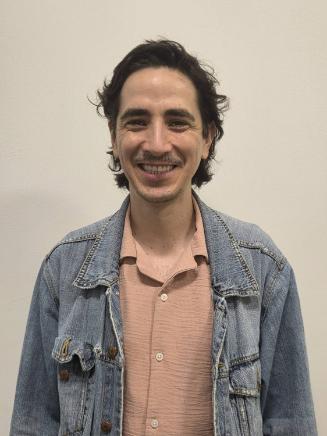
DescriptionAudio file of interview with Logan Matyjewicz. He was interviewed by Francis Goldberg-Doyle on 3 July 2025 in Hartford, Connecticut.
Logan Matyjewicz was interviewed as part of the Connecticut Museum of Culture and History's Community History Project discussing moments of change in his life.
Logan’s moment of change addressed the death of his father about a year and a half ago. His father was a complex figure in his life, and Logan described their relationship as “very odd and toxic.” Logan’s father was very stuck in his ways, and ran from change. Logan expressed that the death of his father was a catalyst to get into tattooing and also impacted many other areas of his personal life. Logan shifted from making more structured art through sign design towards a more open and flexible type of art making with tattooing. Through this shift, he became more comfortable with making mistakes.
When it came to daily life and relationships, Logan found that he was less centered on controlling every aspect of his life. He began to understand what was uncontrollable. Logan has also become more open to new experiences. He expressed that previously, he would find a way out of situations with other people, but now he “talks to people for the sake of talking”. In addition, Logan has developed a new outlook on life as a result of the death of his father, in which he embraces imperfection and aims to implement a personal style into his artwork and tattooing. Logan describes the idea of making his own brand or image through his art, in which his tattooing can follow in the “Logan style.”
Looking to his childhood, Logan was always surrounded by visuals; his older brother would draw, and his father collected comic books and memorabilia. This was a big catalyst for him to make art, though he stopped around middle school because his peers were more interested in sports, and he wanted to appear “cool”, so he put more effort into sports. After his fathers passing, he initially was stifled in art making, and did not make art for a while after the death because he was left in total shock. He explains that the death influenced how he handled art going forward, rather than art playing a role in how he dealt with the death.
Logan Matyjewicz was interviewed as part of the Connecticut Museum of Culture and History's Community History Project discussing moments of change in his life.
Logan’s moment of change addressed the death of his father about a year and a half ago. His father was a complex figure in his life, and Logan described their relationship as “very odd and toxic.” Logan’s father was very stuck in his ways, and ran from change. Logan expressed that the death of his father was a catalyst to get into tattooing and also impacted many other areas of his personal life. Logan shifted from making more structured art through sign design towards a more open and flexible type of art making with tattooing. Through this shift, he became more comfortable with making mistakes.
When it came to daily life and relationships, Logan found that he was less centered on controlling every aspect of his life. He began to understand what was uncontrollable. Logan has also become more open to new experiences. He expressed that previously, he would find a way out of situations with other people, but now he “talks to people for the sake of talking”. In addition, Logan has developed a new outlook on life as a result of the death of his father, in which he embraces imperfection and aims to implement a personal style into his artwork and tattooing. Logan describes the idea of making his own brand or image through his art, in which his tattooing can follow in the “Logan style.”
Looking to his childhood, Logan was always surrounded by visuals; his older brother would draw, and his father collected comic books and memorabilia. This was a big catalyst for him to make art, though he stopped around middle school because his peers were more interested in sports, and he wanted to appear “cool”, so he put more effort into sports. After his fathers passing, he initially was stifled in art making, and did not make art for a while after the death because he was left in total shock. He explains that the death influenced how he handled art going forward, rather than art playing a role in how he dealt with the death.
Object number2024.79.38
NotesSubject Note: The Connecticut Museum of Culture and History’s Community History Project (CHP) is a public-facing initiative, focused on contemporary collecting, gathering items of the recent past as well as from events happening today. This program developed community historians to identify, document, and preserve their experiences as residents of Connecticut, and to share these experiences during a series of community presentations. The project focused on the theme "Redefining Moments of Change." Conneticans share stories of people or events who have changed their lives or how they have sparked change in the lives of others.Cataloging Note: Digitization and access to this collection is supported by a Congressionally Directed grant through the U.S. Department of Education.
On View
Not on view
1 July 2025
April 17, 2026