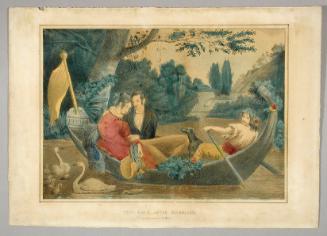
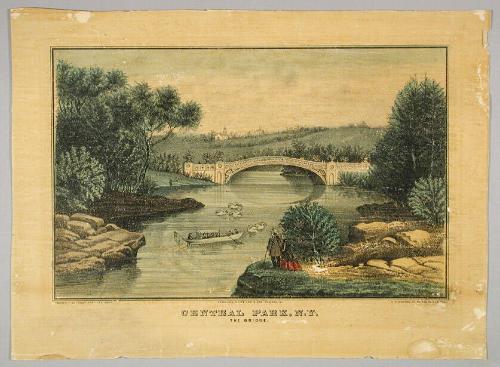
Central Park, N.Y., The Bridge.
PrinterPrinted by
Kellogg & Bulkeley
American, 1867 - 1990
PublisherPublished by
Kellogg & Bulkeley
American, 1867 - 1990
PublisherPublished by
Sammons, White and Clark
American
PublisherPublished by
F. P. Whiting
American, born 1840
Dateafter 1867
MediumLithography; printer's ink and watercolor on wove paper
DimensionsPrimary Dimensions (image height x width): 8 1/16 x 12 1/2in. (20.5 x 31.8cm)
Sheet (height x width): 11 x 15in. (27.9 x 38.1cm)
Sheet (height x width): 11 x 15in. (27.9 x 38.1cm)
ClassificationsGraphics
Credit LineGift of Samuel St. John Morgan
DescriptionAn arched stone bridge crosses a lake surrounded by rocks, trees, and grassy lawns. Flowers or plants grow in large ornamental urns on the bridge abutments. Five swans and a small boat are in the water. Several people are in the boat; one of them uses oars to propel the boat. An awning is over the central section, and a large American flag flies from the stern. A man and a woman stand on the shore in the foreground. A man with a fishing pole stands at the edge of the lake in the left background. Two buildings, both with steeples and therefore apparently churches, are visible in the distance.
Object number1950.188.0
InscribedOn recto, lithographed title beneath image, "CENTRAL PARK, N.Y. / THE BRIDGE."On verso, in red ink, upper left, "986". In pencil, lower right, "Dwr 22" "Print / Box 8 / #42" and accession number.
Collections
- Kellogg Brothers Lithographs
On View
Not on view